
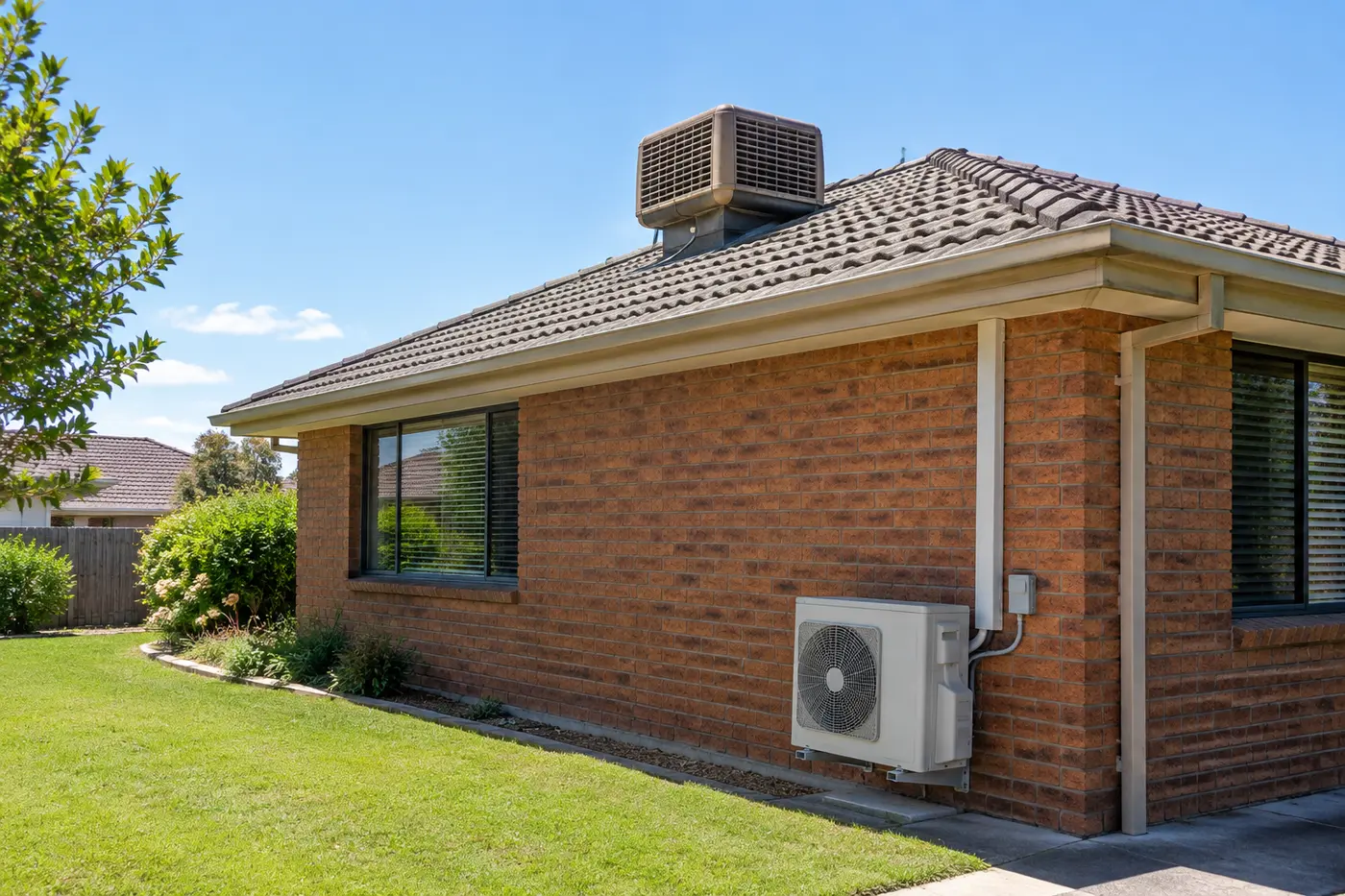
It is a hot January afternoon in Geelong. The northerly has been blowing since breakfast, the evaporative cooler is roaring away, and the house still feels sticky. Then the change comes through, the wind swings south, and by dinner you are hunting for a jumper. If that sounds familiar, you have probably started weighing up refrigerated vs evaporative cooling, and wondering whether the system you have is the right one for this part of Victoria.
We get asked this a lot, usually by people who have lived with an evaporative system for years and are now thinking about a change. Here is how the two actually differ, where each one earns its keep around Geelong, and the questions we would ask before you spend anything.
Two very different ways to cool a room
Evaporative cooling pulls outside air through wet pads on the roof. As the water evaporates, the air cools, and a fan pushes it through ducts into the house. Because it keeps pushing fresh air in, you need windows or doors open so the old air has somewhere to go.
Refrigerated cooling is what most people simply call air conditioning. It uses a refrigerant gas and a compressor to move heat out of the house, the same basic idea as your fridge. Split systems and ducted reverse cycle units are both refrigerated systems. The house stays closed up, and the same indoor air is cooled and filtered as it goes round.
That one difference (fresh air in, or the same air cooled again) explains almost everything else about how they behave.
Geelong weather is why this question is tricky
Evaporative cooling works best when the air outside is hot and dry. Dry air soaks up moisture easily, so the pads can do their job. When the air is already humid, there is far less cooling to be had, and you end up blowing damp, only slightly cooler air through the house.
Geelong gives you both kinds of day. Those dusty northerly days off the inland suit an evaporative system well. But the region also sits on the bay, and the closer you get to the water at places like Barwon Heads, Ocean Grove, Portarlington or Torquay, the more often summer air carries moisture. Muggy nights after a warm day are where evaporative owners tell us they feel let down.
Refrigerated systems are not bothered by humidity in the same way. They cool regardless, and pull some moisture out of the air while they are at it, which is a big part of why the room feels comfortable rather than just breezier.
Heating is usually the deciding factor
This is the bit that surprises people. Most of the Geelong homeowners we talk to are not that unhappy with summer. They are unhappy with their winter heating bill, or with an ageing gas heater, and they realise an evaporative cooler does nothing for them from May to September.
An evaporative system only cools. A reverse cycle refrigerated system heats as well, using the same unit and, in a ducted setup, the same vents. In a climate where you run heating for far more of the year than cooling, that matters. It also means one system to service instead of two.
If you are already thinking about replacing gas heating, have a read of our guide to picking a heating and cooling setup for a Geelong home before you decide on cooling alone.
Evaporative cooling still makes sense in some homes
We are not going to pretend evaporative is always the wrong answer. It has real strengths:
- Constant fresh air, which some households strongly prefer to a closed house
- Low electricity use, since it is mostly a fan and a small water pump
- Good coverage of the whole house on dry days, especially in larger open plan homes
- A good fit for people who like windows open and do not mind the sound of moving air
If your home is further inland, you already have gas or hydronic heating you are happy with, and your main complaint is the odd scorcher, a well maintained evaporative system can be a sensible, affordable choice. Our evaporative cooling guide for Geelong homes goes deeper on that side, including what keeps one running well.
The trade offs people forget to ask about
Running cost is the comparison everyone starts with, and evaporative does use less electricity to run. But it is only part of the picture. These are the things that tend to come up once someone has lived with each system for a while.
Open windows
Evaporative cooling needs the house open. On a hot night that can mean choosing between cool air and leaving windows open while you sleep. On smoky summer days, or when pollen is high in spring, you would rather keep the house shut. A refrigerated system lets you do that.
Water use
An evaporative cooler uses water every time it runs, and the pads, pump and tray need regular attention. A refrigerated system uses no water to cool, though it does produce a little condensation that drains away outside.
Temperature control
With evaporative, you control fan speed and how much water flows over the pads. You cannot really set a temperature and walk away. Refrigerated systems hold a set temperature, and ducted systems can be zoned so you only cool the rooms you are using.
The roof unit
Evaporative coolers sit on the roof, open to the outside air. When we look at older units near the coast, salt air is one of the main things wearing them out. Refrigerated systems have an outdoor unit too, but coastal homes can choose units and protection suited to salt exposure. We cover that in our post on air conditioners for coastal homes near Barwon Heads.
Switching from evaporative to refrigerated has two usual paths
A lot of the work we see is exactly this: an older evaporative unit on the roof, and a household ready for something that also heats.
The first path is a ducted reverse cycle system for the whole house. Evaporative ducts are sized to move a lot of air at low pressure, which is different from what a refrigerated system needs, so we assess the existing ductwork rather than assume it can be reused. The second path is one or more split systems for the rooms that matter most, often the living area and main bedroom, with the old evaporative unit either removed or kept for dry days.
Which one suits you depends on the layout, how many rooms you actually use, and the state of the switchboard. If you are leaning towards the whole home option, our ducted reverse cycle installation service explains how we approach it. Because we hold the refrigeration, electrical and cabling accreditations ourselves, the whole job stays with one accountable team, from taking down the old unit to commissioning the new one.
Three questions settle it for most households
Do you need heating as well? If yes, refrigerated reverse cycle almost always comes out ahead, because evaporative cannot help in winter.
How close are you to the coast? The more humid your summers feel, the less you will get out of evaporative cooling.
Do you prefer a closed, quiet house with a set temperature, or fresh air moving through? That one is personal, and both answers are fine.
We are happy to talk it through on site. Site visits throughout Geelong, the Bellarine Peninsula and the Surf Coast are free and carry no obligation, and beyond a straightforward single split we prefer to measure before quoting. It helps if you know roughly how old the house and your current system are, which way the main living area faces, and whether the switchboard has been upgraded.
Straight answers on refrigerated and evaporative cooling
Which is better, evaporative or refrigerated air conditioning?
Neither is better everywhere. Evaporative suits hot, dry conditions and people who like fresh air moving through the house. Refrigerated cooling works in humid weather too and, in reverse cycle form, heats the home in winter, which is why most Geelong households we see end up choosing it.
Is an evaporative cooler the same as an air conditioner?
No. An evaporative cooler cools air by passing it over wet pads and needs windows open to work. An air conditioner uses refrigerant and a compressor to remove heat from a closed house, and reverse cycle models heat as well.
Is it cheaper to run an evaporative cooler or air conditioning?
An evaporative cooler generally uses less electricity because it is mainly a fan and a pump. It does use water, though, and it cannot heat, so if you also run a separate heater the full running cost picture changes. Zoning a refrigerated system so you only cool occupied rooms also narrows the gap.
What is the downside of evaporative cooling?
It loses much of its cooling power on humid days, it needs windows or doors open, and it gives you no heating. The roof unit also needs regular care to its pads, pump and water tray, and units near the coast can wear faster in salty air.
What is refrigerated cooling?
It is the type of cooling used by split systems and ducted reverse cycle air conditioning. A refrigerant gas carries heat from inside the house to an outdoor unit, so the indoor air is cooled and dried without bringing outside air in.
Can I keep my evaporative ducts if I switch to refrigerated?
Sometimes parts can be used, but it should never be assumed. Evaporative and refrigerated systems move air differently, so the ductwork needs to be checked on site before anyone quotes on reusing it.
If your evaporative system is getting tired, or you are ready for one system that heats and cools, talk to us about a ducted refrigerated upgrade. We will come out, look at the house and the existing ducts, and give you an honest view on whether to switch, add a split system, or keep what you have.