
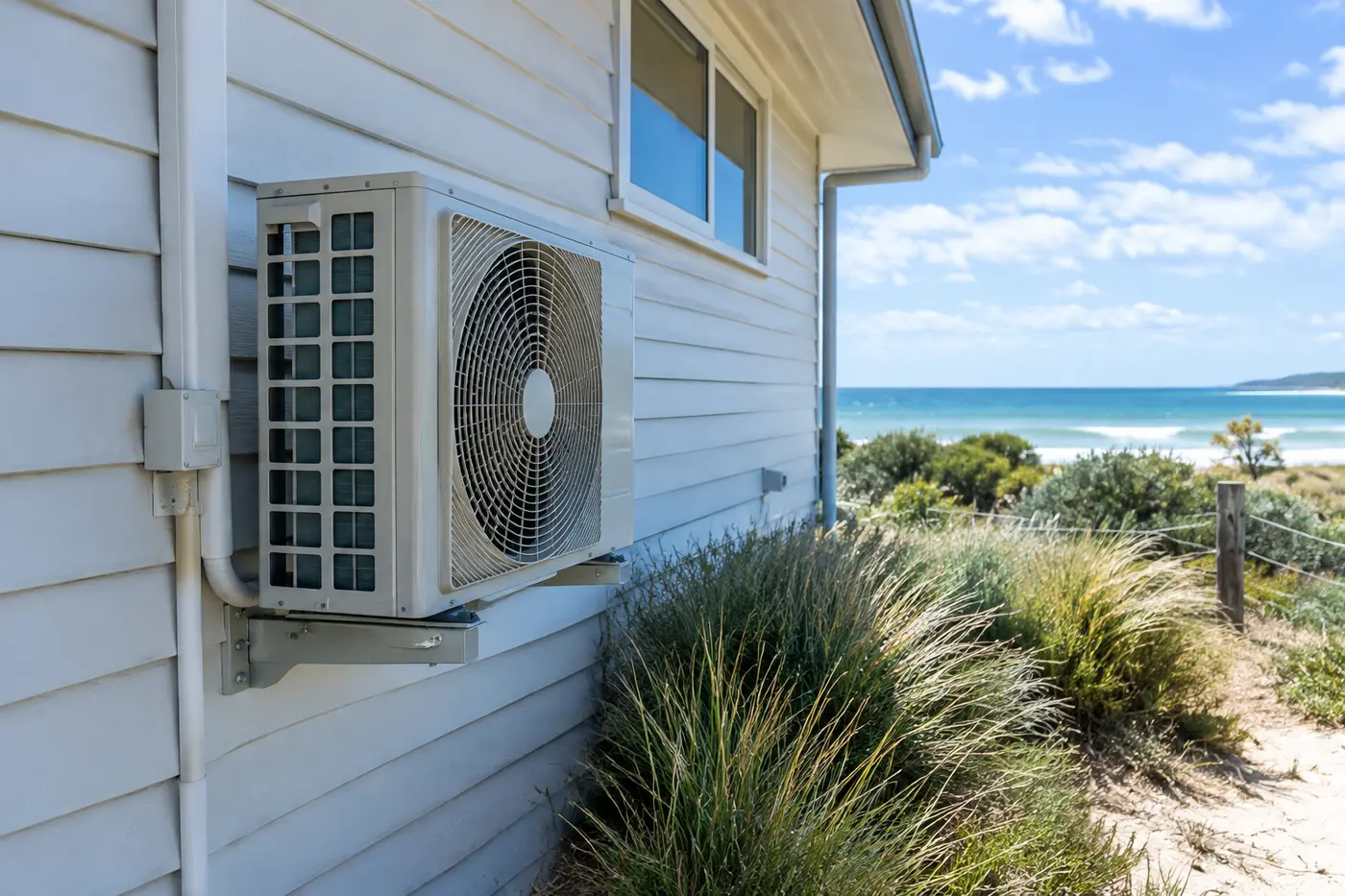
A Barwon Heads homeowner rang us last summer about a split system that was barely four years old. The indoor unit looked new. The outdoor unit, sitting on the side of the house facing the water, had fins that crumbled when you touched them and a mounting bracket streaked with rust. Nothing was wrong with the brand. It was simply the wrong setup for a house that close to the sea, and finding the best air conditioner for coastal homes starts with knowing that difference.
Salt air is the problem. Sea spray carries fine salt particles inland on the breeze, and they settle on anything metal. Add damp air, morning dew and the sand that blows around Barwon Heads, Ocean Grove and Torquay, and the outdoor half of an air conditioner has a much harder life than the same unit would in Highton or Belmont.
The outdoor unit is where coastal systems fail
Every reverse cycle system has two halves. The indoor unit lives in your clean, dry living room. The outdoor unit (the condenser) sits outside in the weather, pushing air across a coil made of thin aluminium fins wrapped around copper pipe. Those fins are what moves heat in and out of your home, and they are also the part salt attacks first.
When the fins corrode, they stop transferring heat well. The system works harder for the same result, power bills creep up, and eventually the coil can develop refrigerant leaks. Salt also gets into the electrical connections and the circuit board inside the outdoor unit, which is often what finally stops a coastal system working. Steel parts suffer too: the cabinet panels, the screws and the wall brackets holding the whole thing up.
So when people ask us which air conditioner is best near the beach, our answer is rarely a brand name. It is a short list of features, plus an install done with the coast in mind.
Four things matter more than the badge on the front
A protective coating on the condenser coil
Several major manufacturers offer outdoor units with a factory coating on the fins, often a blue or gold tinted layer that sits between the aluminium and the salt. Coated coils are not bulletproof, but on a home within sight of the water they make a real difference to how long the coil holds up. If you are comparing quotes, ask each installer whether the outdoor unit they are pricing has a coated coil or is the standard version.
Rust resistant fixings and brackets
This one surprises people. We regularly see outdoor units still running fine while the cheap steel bracket underneath them rusts away. On the coast we prefer stainless or properly galvanised fixings and, where the layout allows, a solid ground mount instead of a wall bracket hanging off the weather side of the house.
A sensible spot for the outdoor unit
Placement costs nothing, and it can matter as much as the unit itself. The worst spot is usually the side of the house that cops the full sea breeze. A sheltered wall on the far side, out of the direct spray, will slow corrosion down. The unit still needs clear air around it to breathe, so it is a balance, not a box tucked into a cupboard. It is one reason we prefer to measure and look at the property before quoting anything beyond a straightforward single split.
A warranty you have actually read
Some manufacturer warranties carry conditions for systems installed close to the sea, such as particular models, coatings or servicing requirements. Before you buy, read the warranty for the exact model you are being quoted and check what it says about coastal installs. It takes a few minutes and avoids an unpleasant surprise later.
Split, multi-head, ducted or evaporative: how they fare near the beach
The type of system still matters, and coastal conditions shift the usual trade-offs a little.
Split systems are the most common choice we install in beachside homes. They are simple, efficient for heating as well as cooling, and if one outdoor unit does suffer from the salt, you are replacing one modest unit rather than a whole house system. For most holiday houses and smaller homes, a quality reverse cycle split with a coated coil is hard to beat. Our split system installation team plans the outdoor position as carefully as the indoor one for exactly this reason.
Multi-head systems run several indoor units off one outdoor unit. That means fewer condensers exposed to the weather, which is a genuine advantage on a tight coastal block. The flip side is that if that one outdoor unit fails, every room loses its heating and cooling at once.
Ducted reverse cycle works well in larger coastal homes, and the indoor parts are hidden away in the roof. But it relies on one large outdoor unit, so coil protection and placement become even more important. Ask specifically whether a coated version is available.
Evaporative cooling works by passing air over wet pads, and it performs best when the outside air is dry. Coastal air is often more humid, especially on still summer evenings, so an evaporative system near the water may not cool as well as it would further inland. It also pulls large volumes of outside air, salt included, through the roof unit. It can still suit some homes, but it is rarely our first suggestion right on the coast. If you are weighing up every option for the whole house, our guide to choosing a heating and cooling system for a Geelong home walks through each one in more detail.
There is no neat line for how close is too close
A house on the dunes at Barwon Heads is obviously exposed. A house a few streets back, behind other buildings and trees, gets far less spray. Wind direction, how open the block is and whether the outdoor unit faces the water all play a part.
A simple test: look at what is already outside. If the car, the outdoor furniture, the screen door hinges or the neighbour’s air conditioner show rust or white crusty deposits, treat your home as coastal and plan the system accordingly. If you are still unsure, it is something we check on a site visit. You can read more about the work we do around the river mouth and peninsula on our Barwon Heads air conditioning page.
Maintenance does a lot of the heavy lifting
Even the best coastal setup needs looking after. Salt builds up on the coil over time, and a crusted coil both performs worse and corrodes faster.
Between services, you can gently hose the outdoor unit with fresh water to wash salt off the fins. Turn the system off first, use a soft spray rather than a high pressure jet (which bends the fins), and keep water away from the electrical cover. Keep sand, leaves and garden growth clear of the unit too.
A proper service goes further. A technician can clean the coil thoroughly, check electrical connections for early corrosion, look over the brackets and fixings, and pick up small problems before they become a dead unit in the middle of January. For homes near the water, regular air conditioner servicing and maintenance is one of the cheapest ways to get more years out of the system.
Our shortlist for a beachside home
If you live close to the water on the Bellarine Peninsula or the Surf Coast, this is what we would look for:
- reverse cycle, so it heats through winter as well as cooling in summer
- an outdoor unit with a factory coated coil
- stainless or galvanised fixings, ideally a ground mount
- the outdoor unit placed out of the direct sea breeze
- a warranty that covers coastal installs for that model
- a service plan you will actually keep up
Get those right and the brand choice becomes much less important. Get them wrong and even a premium unit can look tired within a few summers.
Because we hold the refrigeration, electrical and cabling accreditations ourselves, the whole job stays with one accountable team, from choosing the unit to mounting it and wiring it in. Site visits throughout Geelong, the Bellarine Peninsula and the Surf Coast are free and carry no obligation. If you want a system set up to last near the sea, ask us about a coastal split system install and we will come and work out where the outdoor unit should go.
Common questions about air conditioning near the coast
What is a coastal air conditioner?
It is usually a standard model with extra protection against salty air, most often a factory coating on the outdoor coil and sometimes upgraded fixings or cabinet treatment. Some manufacturers sell specific coastal versions of their units. The install matters just as much, because placement and rust resistant brackets protect any system, coated or not.
What is the most reliable air conditioner brand in Australia?
Most of the major brands sold here make reliable units. Near the coast, reliability depends far more on whether the outdoor unit is protected from salt, how it is installed and how well it is maintained. We would rather put a well chosen, well placed unit in a beach house than an unprotected premium one in the worst spot on the block.
What AC brands should I stay away from?
Rather than avoiding brands, avoid situations: units with no local service support, no available spare parts, or a warranty that excludes installs near the sea. Very cheap units bought online and installed without a proper plan are the ones we most often see failing early in coastal suburbs.
What is the best central air conditioner for coastal areas?
For whole house cooling near the water, a ducted reverse cycle system with a coated outdoor coil is usually the strongest option. Evaporative systems tend to struggle more on humid coastal days and draw salty air through the roof unit. Whatever you choose, put the outdoor unit somewhere sheltered and keep it serviced.
Can I protect the air conditioner I already have from salt air?
Yes, to a point. Rinsing the outdoor unit gently with fresh water, keeping it clear of sand and plants, and booking regular services all slow corrosion down. If the unit sits in the full sea breeze, moving it to a sheltered spot can also be worth discussing with your installer.