
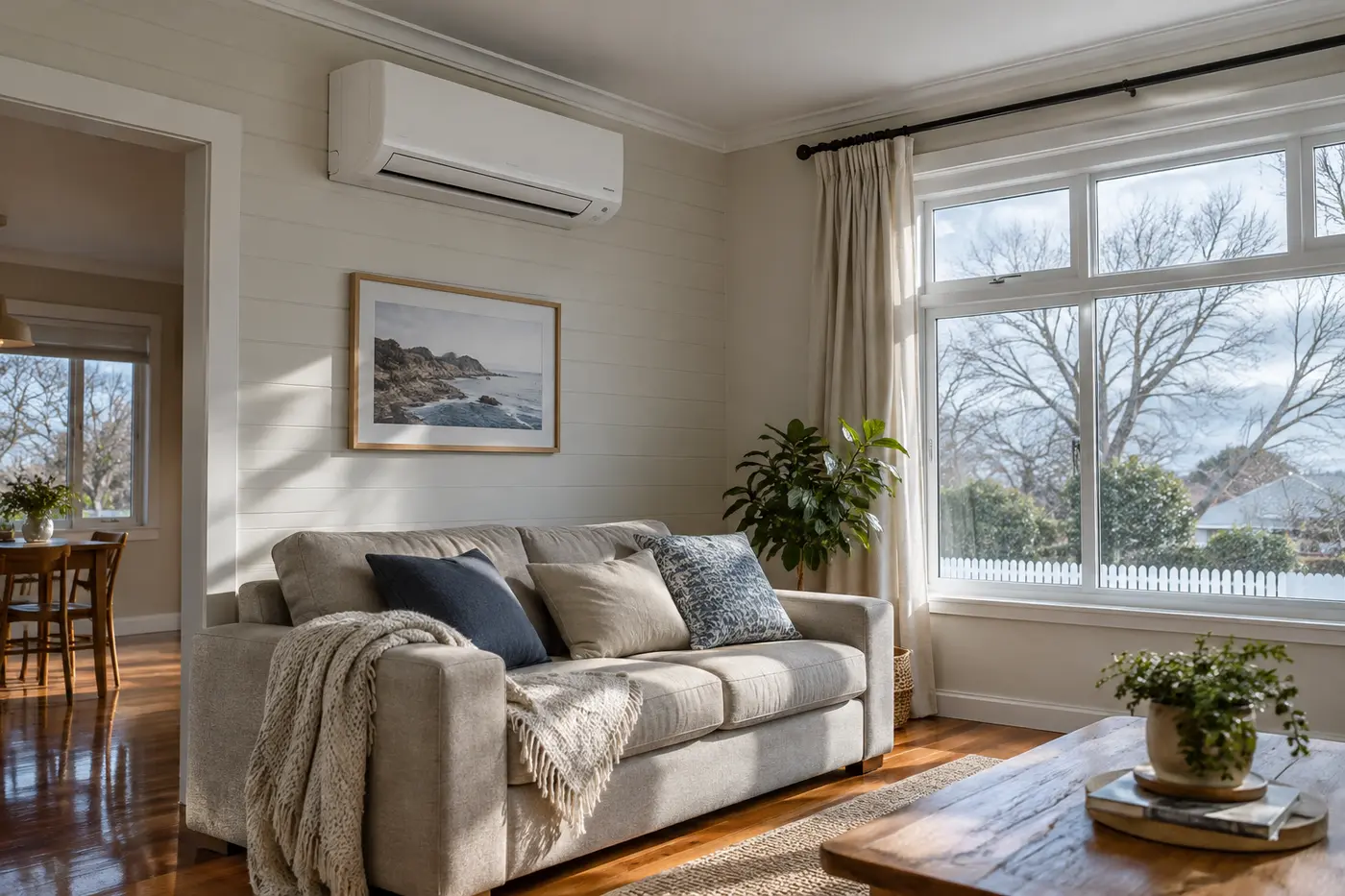
Most people who ask us for the best air conditioner in Geelong have already spent an evening on comparison sites. They come away with a shortlist of three brands, five model numbers and no clearer idea of which one belongs on their wall. That’s not their fault. National “best of” lists are written for an average Australian home, and a Geelong house isn’t average. It asks its system for heat far more often than for cooling, and plenty of them sit close enough to the bay or the surf to taste the salt.
So here’s how we’d actually choose, in the order it matters.
Heating decides it here, not cooling
This one surprises people. They shop for an air conditioner in a January heatwave, but the unit does its hardest and longest work from May to September. A reverse cycle system (one that runs the refrigeration process backwards to pump heat into the room) is doing the heavy lifting on cold, damp mornings, when the outdoor unit has to pull warmth out of chilly air.
That changes what you should look at on the spec sheet. Every split system lists two capacities, one for cooling and one for heating. We tell clients to read the heating figure first. Two units can look identical on cooling and differ noticeably on heating, and the better heater is usually the better buy for a Geelong living room.
It’s also worth checking how a unit performs when it’s genuinely cold outside, not just on a mild test day. Some models hold their output well as the temperature drops. Others fade, then pause to defrost the outdoor coil, and the room goes lukewarm right when you want it warmest. If the brochure only gives figures at mild conditions, ask the installer for the low temperature data.
The energy label has a heating side too
Australia’s zoned energy rating label splits the country into hot, average and cold climate zones, with separate star ratings for cooling and heating in each. Most buyers glance at the biggest star number and move on. Look at the heating stars instead, and compare the same zone across every model on your shortlist. A unit that scores well on heating will cost less to run through a Geelong winter, which is when it works hardest.
Size it properly or the brand won’t matter
We see this every week. A good quality unit that’s too small for the room runs flat out all winter, never quite gets there, and wears faster. An oversized one blasts the room to temperature, throttles back, and leaves you with uneven comfort and a higher purchase price for nothing.
The right size depends on floor area, ceiling height, insulation, window area and which way the room faces. A west facing lounge in an old Newtown weatherboard needs a very different answer from a well insulated bedroom in a new Armstrong Creek estate. We’ve written a separate guide on working out what kW capacity your room needs, and it’s worth reading before you compare any models at all.
Close to the water, the outdoor unit matters most
If you live in Barwon Heads, Ocean Grove, Torquay, Portarlington or anywhere else with a steady sea breeze, salt air is the thing most likely to shorten your system’s life. It settles on the outdoor coil and slowly corrodes the fins and fittings. For these homes the best unit is often the one with proper corrosion protection on the outdoor coil, mounted where it’s sheltered from the prevailing wind and easy to rinse.
We cover this in more depth in our post on picking a system that copes with coastal salt air. The short version: ask about coil protection before you ask about Wi-Fi.
Daikin, Mitsubishi and the other big names are closer than the ads suggest
It’s the question we get asked most, and the honest answer is a bit flat. The established brands sold through Australian installers, names like Daikin, Mitsubishi Electric, Fujitsu and Panasonic, all make good reverse cycle split systems. Their mid range models sit closer together than the marketing implies, and each brand’s strengths shift as models are updated.
What separates them in practice usually comes down to a few things:
- heating output and efficiency at low outdoor temperatures
- indoor unit noise on its quietest setting, which matters for bedrooms
- local parts and warranty support
- whether the controls and app suit the way your household lives
The bigger difference is almost always the installation. A premium unit with a poorly run pipe, a badly placed outdoor unit or a rushed electrical connection will underperform a modest unit installed carefully. That’s the pattern we see when we’re called out to systems that “never worked properly” from day one.
The right unit for a lounge is the wrong one for a bedroom
Living areas want capacity and good air throw, so the warmth reaches the far end of the room and not just the couch under the unit. Bedrooms want a quiet indoor unit, gentle airflow that isn’t aimed at the bed, and a sensible night mode.
If you’re trying to condition several rooms, the question shifts again. One large split in the hallway won’t heat three bedrooms behind closed doors. That’s when a multi head system, separate splits or ducted starts to make sense, and the choice becomes about the layout of the house more than the brand on the front panel.
Six questions that narrow the field fast
When a Geelong client asks us what to buy, we work through these before any brand comes up:
- Which room is it for, how big is it, and which way does it face?
- Is it mainly for winter heating, summer cooling, or both equally?
- How close is the house to the coast?
- Is noise a concern (bedroom, study, nursery)?
- Where can the outdoor unit sit, and how long is the pipe run?
- Can the switchboard handle it?
Once those are answered, the sensible options usually narrow to two or three models. Choosing between them is then a fairly relaxed decision about features and budget.
If a split system is where you’re heading, our split system installation team handles the measuring, sizing and placement that let any of those models perform the way the label says. We hold the refrigeration, electrical and cabling accreditations ourselves, so one team is accountable for the whole job.
Reviews get you a shortlist, a site visit gets you the answer
Standing in the room tells us things no comparison site can. Site visits throughout Geelong, the Bellarine Peninsula and the Surf Coast are free and carry no obligation, and beyond a straightforward single split we prefer to measure before quoting. Have the approximate age of the house, your current system and the orientation of your main living area handy, then book a split system assessment and we’ll tell you which unit we’d put in and why.
Common questions about choosing an air conditioner in Geelong
What is the best split system for heating and cooling?
For a Geelong home, it’s a correctly sized reverse cycle inverter split with strong heating stars on its energy label and good output in cold weather. Heating matters more than cooling here, so compare heating capacity and heating efficiency first. A careful installation matters as much as the model.
Is Daikin better than Mitsubishi?
Neither is better across the board. Both make reliable reverse cycle systems, and the gap between comparable mid range models is small. Compare the specific models on heating performance, indoor noise and warranty support rather than on the badge.
Which AC brand is best in Australia?
No single brand wins for every home. The established brands with local parts and warranty support are all sound choices. What decides the result is getting the right capacity for the room and a proper installation.
What AC brands should I stay away from?
We’d be cautious with any unit that has no local warranty support, patchy parts availability, or heating figures only quoted at mild conditions. A budget unit can be fine in a small spare room, but it’s a risky choice for a living area you’ll heat every winter evening.
Which split system air conditioner is best rated in Australia?
Ratings shift as manufacturers release new models, so last year’s ranking may not apply now. Use the zoned energy rating label to compare heating and cooling efficiency in the same climate zone, and check the quiet setting noise level if the unit is going in a bedroom.
Do coastal Geelong homes need a different air conditioner?
Often, yes. Homes near the water should look for an outdoor unit with corrosion protection on the coil, mounted out of the direct sea breeze. Regular rinsing and servicing then help it last.