
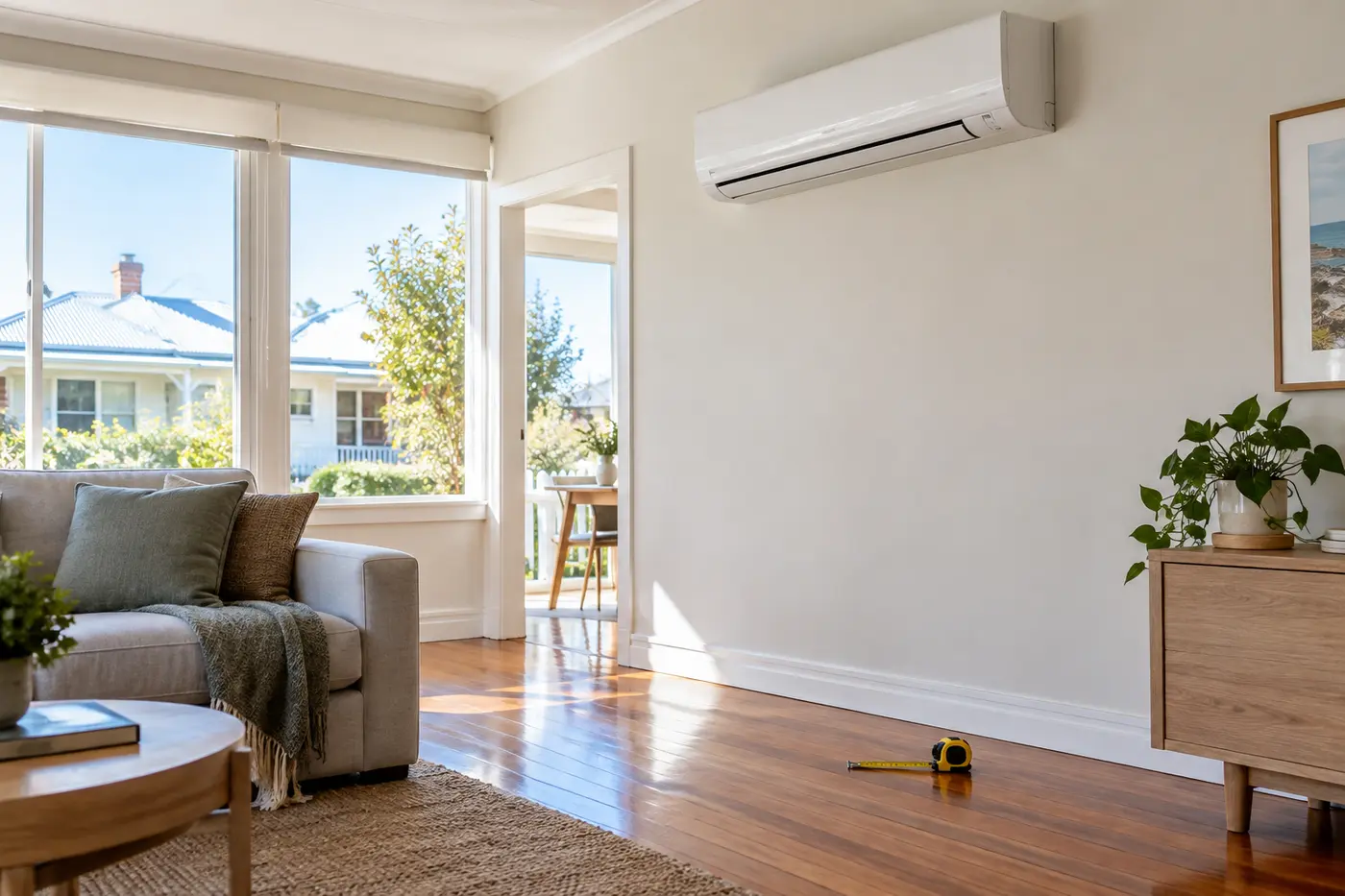
Someone measures their lounge room, types the numbers into an online calculator, and gets told they need a 5 kW unit. Their neighbour, in an almost identical house two doors down, was told 7 kW. Both people end up asking us the same thing: what size air conditioner do I need, really?
The honest answer is that floor area gets you into the right neighbourhood, and the house decides the street number. In Geelong that matters more than most places, because a lot of us run our split systems harder in July than in January. A unit sized only for summer can feel fine on a warm afternoon and then struggle on a cold, windy winter night.
Air conditioner size means output, not the box on the wall
When people talk about the size of an air conditioner they mean its capacity, measured in kilowatts (kW). That number is how much heat the system can move into or out of a room. It is not how much electricity it uses, and it has little to do with how big the indoor unit looks.
Reverse cycle systems (the kind that both heat and cool) carry two capacity figures: one for cooling and one for heating. The heating figure is usually a bit higher. For a Geelong home, that second number deserves at least as much attention as the first.
Floor area is the starting point, nothing more
Most online charts work from square metres. As a rough guide, they tend to put a small bedroom or study at around 2.5 kW, a medium bedroom or living space somewhere between 3.5 and 5 kW, a large lounge at 6 to 7 kW, and big open plan areas at 8 kW or more. Those bands are a fair place to begin a conversation.
The trouble is that a chart only knows the size of the floor. It has no idea whether the room sits under an uninsulated roof, faces west into the afternoon sun, or opens straight onto a kitchen and dining area with no doors in between. Those details are why two rooms with the same measurements can need very different units.
Five things that push the number up or down
These are the factors we look at on almost every site visit. Some of them move the answer a little. A couple of them move it a lot.
Ceiling height changes the volume of air
Charts generally assume a standard 2.4 m ceiling. Plenty of the older homes we work in around Newtown and Geelong West have ceilings well above that, and some newer builds have raked or vaulted sections over the living area. More height means more air to heat and cool, so the unit needs more capacity than the floor area alone suggests.
Open plan living counts as one room
If the kitchen, dining and family room all flow into each other, the air conditioner has to deal with the whole space, not just the bit where the couch sits. This is the most common sizing mistake we see, and it shows up a lot in newer estates like Armstrong Creek where open plan designs are the norm. Once a space gets large or oddly shaped, one big wall unit may not be the best answer at all. Our comparison of ducted and split systems covers where that line usually falls.
Windows and orientation decide the summer load
Big west or north facing windows let in a lot of heat on a summer afternoon. A south facing room with small windows stays cooler without any help. Orientation is one of the details we ask people to have ready before we visit, because it changes the summer cooling load more than most people expect.
Insulation decides the winter load
A well insulated home holds onto the heat your system puts in. An older weatherboard with little or nothing in the ceiling, gaps around the floorboards and single glazed windows lets it leak out just as fast. In those homes we often find the winter heating load, not the summer cooling load, is what sets the size.
Wind and exposure matter more than people think
Homes on the coast and on exposed blocks around the Bellarine and Surf Coast cop cold winds through winter. Air leakage rises when the wind is up, which is exactly when you want the heater working hardest. A sheltered home in a leafy street can often get away with a smaller unit than one facing the weather.
In Geelong, size for winter as well as summer
This one surprises people. Most sizing advice online is written with summer cooling in mind, which makes sense in Brisbane and less sense here. Many Geelong households use their reverse cycle split as the main heater from May to September.
Reverse cycle systems pull heat from the outside air, and on very cold mornings they have less to work with. A unit that just copes on a mild winter day can fall behind when the temperature drops overnight. So when we size a system for a living area here, we check the heating capacity against what the room actually loses on a cold night, not only the cooling figure printed on the brochure.
Bigger is not automatically better
It is tempting to go up a size just to be safe. Sometimes that is the right call. Often it is not.
An oversized unit reaches the set temperature fast, then switches off, then on again. That short cycling wears the compressor, leaves cooled rooms feeling clammy because the unit never runs long enough to pull moisture out of the air, and costs more to buy in the first place. An undersized unit has the opposite problem: it runs flat out for hours, never quite gets there, and pushes your power bill up while doing it.
The size you choose also affects the installation itself. Larger units can need a longer or heavier pipe run, a bigger outdoor unit position, and occasionally switchboard work, all of which show up in the quote. Our guide to what goes into split system installation pricing explains how capacity and site conditions feed into the final number.
Online calculators are useful, but they cannot see the room
Tools like the AIRAH calculator published through CHOICE ask better questions than a basic square metre chart, including insulation, window size and orientation. They are well worth five minutes before you start shopping, mainly so you walk in with a realistic range in mind.
What no calculator can do is spot the uninsulated section of ceiling over an extension, the draughty sliding door, or the hallway that will steal warm air from the lounge every time a door is left open. That is why, beyond a straightforward single split, we prefer to measure before quoting. Site visits throughout Geelong, the Bellarine Peninsula and the Surf Coast are free and carry no obligation, and the measurements we take there are what our split system installation team works from when choosing a unit.
What to have ready before you ask for a quote
If you want an accurate recommendation quickly, gather a few details first. They are the same ones we ask for on our contact form:
- approximate age of the property
- current heating or cooling system and its age
- which way the main living area faces
- whether the switchboard has been upgraded
- rough room measurements, including ceiling height
With that in hand, most sizing conversations take a few minutes rather than a few phone calls.
Common questions about air conditioner sizing
What size air conditioner do I need for my home?
Start with the floor area of each room you want to heat or cool, then adjust for ceiling height, windows, orientation and insulation. In Geelong, check the heating capacity as carefully as the cooling capacity, since many homes rely on the system through winter. For anything beyond a single bedroom or study, an on site measure gives a far more reliable answer than a chart.
Are online air conditioner size calculators accurate?
They are a good starting point and the better ones ask about insulation and windows, not just square metres. They cannot see air leaks, extensions, open doorways into hallways or how exposed your block is to wind. Use one to get a realistic range, then have the room checked before you buy.
Which air conditioner is the most energy efficient?
Efficiency depends on the model and on getting the size right for the room. A highly rated unit that is badly oversized or undersized will still waste energy. Compare star ratings on the Zoned Energy Rating Label, and look at the cold zone figures if you plan to use the system for heating in Geelong.
What is a SEER rating?
SEER stands for seasonal energy efficiency ratio. It measures how efficiently a system cools across a whole season rather than at a single test point. In Australia you will mostly see this expressed through the star ratings on the energy label, which also show a heating figure for reverse cycle units.
Which is colder, 24C or 16C, and will a lower setting cool the room faster?
16C is the colder setting, but setting it lower does not make most systems cool the room any faster. The unit works at its own pace toward whatever target you give it, so a very low setting mostly means it keeps running longer and uses more power. A correctly sized system set to a sensible temperature will feel better and cost less to run.
If you are weighing up a new split system and want the size worked out properly for your rooms rather than guessed from a chart, our Geelong split system installers can measure up on a free, no obligation site visit and talk you through the options.