
It is the first properly hot afternoon of the year. A northerly is pushing across Geelong, you switch on the split system you have not touched since March, and it hums along quite happily while blowing air that is barely cooler than the room. Your air conditioner is not cooling, and of course it picked today.
We get a run of these calls every November and December. A fair share of them turn out to be things you can check yourself in ten minutes or so. The rest need a technician, and knowing which is which saves you a wasted afternoon and possibly a wasted call-out.
Start with the boring checks, because they fix more than you would think
Before anything else, pick up the remote. Make sure it is set to Cool (a snowflake symbol on most brands), not Dry, Fan or Auto. Set the temperature well below what the room is sitting at. Settings get bumped over winter, and a unit left in Heat mode will keep doing exactly that.
Then check the power side. If the indoor unit lights up but nothing happens outside, look at your switchboard for a tripped circuit and check the isolator switch beside the outdoor unit. If a breaker trips again as soon as you reset it, stop there. That is an electrical fault, not something to keep flicking on and off.
Last of the easy ones: give it time. After a long rest, many inverter systems take a few minutes to ramp up, and some pause while they work out what you are asking for. Stand under the unit for a good five minutes before you decide it is broken.
A clogged filter is the most common culprit we find
If the settings are right and air is coming out but it feels weak or lukewarm, open the front panel of the indoor unit and pull out the mesh filters. In most homes we visit after a winter of heating, they are grey with dust, pet hair and kitchen grease. Air simply cannot get across the cold coil fast enough, so the room never cools down.
Most split system filters can be rinsed under a tap. Let them dry fully in the shade, clip them back in and try again. If you ran the heater all winter and never did this, there is a good chance this is your fix.
Ducted systems have a return air grille instead, usually in a hallway ceiling. The filter sits behind it and needs the same treatment.
The outdoor unit has to breathe too
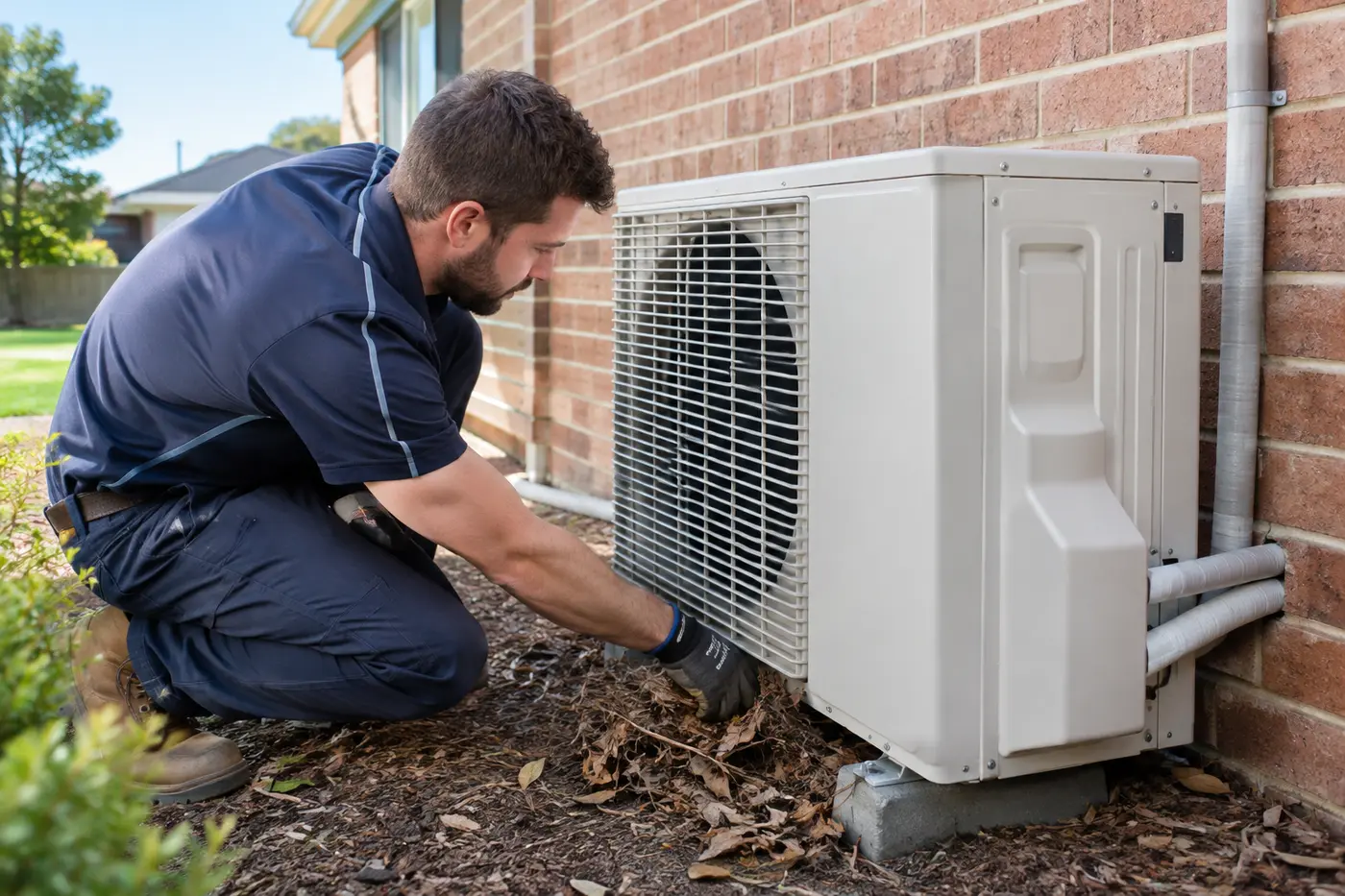
The outdoor unit is where the heat from inside your house gets dumped. If it cannot shed that heat, the whole system loses its punch. Walk around the side of the house and have a look. Autumn leaves packed against the fins, a pot plant that has grown into it over winter, a wheelie bin parked right in front, a new shade sail trapping hot air: we see all of these.
Clear the space around it and gently hose any dirt off the fins from the outside. Do not use a pressure washer, as the aluminium fins bend flat very easily. In Bellarine and Surf Coast homes, salt air builds a crust on the coil over time, which slowly cuts performance. We wrote more about that in our guide to choosing a unit for salty coastal conditions.
Ice on the pipes means turn it off
If you see frost or ice on the copper pipes, on the outdoor unit, or behind the indoor unit’s front panel, switch the system off or run it on Fan only and let it thaw. Running it frozen can damage the compressor, which is the most expensive part of the system.
Ice usually points to one of two things: very poor airflow (often that filter again) or a refrigerant problem. If it ices up a second time with clean filters, it needs a technician.
When it is time to stop and call someone
Some faults are simply not owner jobs. These are the signs we would want to hear about:
- The outdoor fan spins but the unit never gets warm at the back, or the compressor clicks on and off
- The outdoor unit does not start at all, even with power on
- Ice keeps coming back after you have cleaned the filters
- A hissing or bubbling sound near the pipes, or oily marks around the joints
- Flashing lights or an error code on the indoor unit
- Water dripping inside, which often goes hand in hand with poor cooling
Low refrigerant is the big one. Air conditioners do not use up their gas the way a car uses fuel. If the level is low, it has leaked somewhere, and topping it up without finding the leak means you will be in the same spot next summer. Refrigerant work has to be done by someone licensed to handle it. Our team holds the refrigeration, electrical and cabling accreditations ourselves, so the same technician can chase a gas leak, test a failed capacitor or sort out a wiring fault without handing you on to someone else.
If water is coming out of the indoor unit as well, our article on why a split system starts dripping inside covers the drain and coil problems that tend to show up alongside poor cooling.
Sometimes the unit is fine and the room is the problem
This one surprises people. If the air coming out is genuinely cold but the room still will not cool down, the system may simply be too small for the space, or it is fighting a lot of heat coming in. Unshaded west-facing windows, an open-plan living area that has grown since the unit went in, or a hot roof space over thin insulation can all overwhelm a unit that is otherwise working perfectly. If that sounds like your house, the fix is a properly sized system rather than another repair, and our planning guide for split system installation walks through how we size a room.
A service before summer heads off most of this
Most of the cooling faults we see in December could have been picked up in October. A proper service cleans the coils as well as the filters, checks the refrigerant pressures, tests the electrical parts and clears the drain. It is far easier to book that on a mild spring day than to join the queue during a heatwave.
If you have run through the checks above and your system still is not cooling, our air conditioner servicing and repair team works across Geelong, the Bellarine Peninsula and the Surf Coast. Tell us the brand, roughly how old the unit is and what you have already tried, and we can usually narrow it down before we arrive.
Common questions about an air conditioner not cooling
Why is my AC running but not cooling?
The most common reasons are the wrong mode on the remote, dirty filters or a blocked outdoor unit. If those all check out, low refrigerant from a leak or a failed electrical part such as a capacitor are the next likely causes, and both need a licensed technician.
Should you turn off AC if it’s not cooling?
Yes, if you see ice on the pipes, hear grinding or hissing, or a breaker keeps tripping. Running a struggling system can turn a small repair into a compressor failure. If it is just weak and you have not checked the filters yet, turn it off, clean them and try again.
How do I reset an AC that is not blowing cold air?
Turn the unit off at the remote, then switch off the circuit breaker or outdoor isolator and leave it for a few minutes before turning it back on. That clears minor glitches in the control board. If it still blows warm air after a reset and the settings are correct, the cause is mechanical rather than electronic.
Why is my house so hot even with the AC on?
Often the unit is working but is undersized for the room or losing the battle against heat through west-facing glass and a poorly insulated roof. Closing blinds on the sunny side and shutting doors to unused rooms helps. If it never keeps up on hot days, a larger or additional unit may be the real answer.
Is it worth repairing an old air conditioner that won’t cool?
It depends on the fault. A blocked filter, a cheap electrical part or a small leak is usually worth fixing. A failed compressor on an older system often costs enough that replacing the unit makes more sense, and a good technician will tell you plainly which side of that line you are on.